Newsletter Archive

UP IN SMOKE
GAME ON!
October 23rd, 2012
THE 12 STEPS TO TAILGATING ENLIGHTENMENTPLUS… FIRECRACKER CHICKEN WINGS FOR SMOKING THE COMPETITION
There’s nothing like a picnic in a parking lot to get a sports fan’s blood pumping. Visit any college stadium on a fall Saturday, and you’ll find parties on steroids sprung spontaneously up from the asphalt. Not that you need a customized RV, inverter-powered plasma screen TV, or military strength Margarita blenders and sound system for a great party. As far as I’m concerned, all you
really need is a grill. (OK, maybe 2 grills.) You also need passion, for that’s what separates the diehard tailgaters from the amateur. Happily, passion for tailgating is contagious.
Americans have been tailgating for a long time. Ever since 1869, to be precise, when the Princeton and Rutgers football teams met to compete in a farm field turned gridiron. Students brought lunches to the game in baskets and served them off the tailgates of farm wagons.
Flash forward to today, when more than 20 million Americans now tailgate. (Not including the ones who ride your bumper on your workday commute.) And like football, tailgating has become a competition sport of its own—especially in the last quarter of the season. Which is why we’re sharing our 12 Steps to Tailgating Enlightenment, plus a sizzling new recipe for Firecracker Chicken Wings.
May the best team win!
The 12 Steps to Tailgate Enlightenment:
- Be organized and plan ahead. Make a master list of ingredients, cooking equipment, and serving supplies before you leave home. Map out your tailgate area on paper before you arrive at the stadium.
- Plan the entire meal on the grill, emphasizing foods that can be eaten out of hand while standing. Start with quick appetizers you can grill on the spot, like grilled garlic bread or quesadillas. Finish with a grilled dessert, like the Uptown S’mores in Barbecue Bible.
- Do as much of the advanced prep work as you can at home. Store the items by course and dish in marked containers to bring to the game.
- Segregate food and beverages in separate coolers. There’s nothing worse than plunging your hand into a raw chicken when you think you’re grabbing a beer.
- Segregate hot foods and cold foods in separate coolers. Use reusable gel packs for the latter.
- It’s OK for your guests to bring side dishes if they desire. It’s OK to ask them. Just coordinate ahead of time to make sure what they bring meshes with your menu.
- Arrive early if parking is a free-for-all, or send in a scout to reserve a good parking spot. Remember the old adage in the hotel business: location, location, location.
- Shop restaurant supply stores for food storage containers and disposable aluminum foil pans and trays. I buy the latter by the case: you can’t beat them for cooking, serving, and clean-up.
- Build your menu around a large chunk of meat that serves lots of people but that needs little tending such as a pork loin roast, tri-tip, brined turkey breast, or ham. All can be cooked over medium heat (350°F) in two hours or less, and all make great sandwiches.
- No Wisconsin tailgate party would be complete without bratwurst. I take a rather heretical approach: I indirect grill the brats at medium heat for about 30 minutes, tossing soaked hickory chips on the coals to generate wood smoke. You still get a crackling crisp casing and indirect grilled brats are much less temperamental and prone to flare-ups.
- Practice “leave no trace” tailgating. Recycle your bottles and dispose of your trash. Extinguish any lit charcoal in a metal bucket filled with water. Remember, charcoal can burn for 12 hours—even if the fire looks dead.
- Don’t forget to bring game day tickets, including any required parking passes or stickers. (Yeah, we’ve forgotten those once or twice, too.)
 FIRECRACKER CHICKEN WINGSServes: 6 as an appetizer, 4 as a light main course
3 to 3-1/2 pounds chicken wings
For the rub:
1 tablespoon hot or smoked paprika
1 teaspoon sea salt
1 teaspoon freshly ground black pepper
1 teaspoon onion powder
1 teaspoon garlic powder
1/2 teaspoon celery seed (optional)
2 tablespoons sesame oil or vegetable oil
For the sauce:
1 stick (8 tablespoons) unsalted butter
3 red jalapeno peppers (or other hot peppers—preferably red—or to taste), stemmed and thinly sliced crosswise
1/2 cup cilantro leaves
1/2 cup Sriracha—Thai hot sauce
1 to 2 tablespoons honey (optional)
1/2 teaspoon liquid smoke (optional)
You’ll also need: 1-1/2 cups hardwood chips, soaked in water to cover for 30 minutes.
Set up your grill for indirect grilling and preheat to medium-high (400°F).
Cut the chicken wings into 2 sections, the drumette and the flat, discarding the wing tip (or save it for stock). Place the wings in a large mixing bowl. Sprinkle the paprika, pepper, salt, onion and garlic powder, and celery seed over the chicken and toss to mix. Add the sesame oil and toss to mix.
Arrange the chicken wings on the grate over the drip pan away from the heat. Leave a little space between each wing. Toss the wood chips on the coals (or place in the smoker box of your gas grill.) Indirect grill the wings until darkly browned and cooked through, 30 to 40 minutes depending on the size of the wings. To check for doneness, make a slit in the thickest part of the largest drumette: there should be no traces of pink in the meat, though you might get a pink smoke ring near the bone.
Meanwhile, melt the butter in skillet. (Bubbles will dance when you dip a chile slice in the butter.) Add the chile slices and cilantro to the butter and cook over medium-high heat until fragrant, 2 minutes. Stir in the Sriracha and bring to a boil.
Transfer the chicken wings to a large shallow bowl. Pour most of the butter mixture over them and toss to mix. Pour the remaining butter mixture on top and serve at once.
Yours in righteous grilling,
Steven Raichlen, Grill Master and Editor-in-Chief
Nancy Loseke, Features Editor


UP IN SMOKE
BY POPULAR DEMAND: OUR FIRST VIDEO-ENHANCED EBOOK!
August 14th, 2012
Dear Up in Smoke Subscriber,
You asked. We listened. Now Workman Publishing and I are thrilled to announce the publication of my first ever video-enhanced ebook: Secrets of the World’s Best Grilling: A Video and Recipe Master Class.


Specially designed for the iPad, it features 50 of my favorite recipes from
Planet Barbecue!, plus step-by-step slideshows and instructional videos that demonstrate how to grill the recipes from start to finish. (Fans of my PBS show Primal Grill may recognize the setting.)
The result of my extensive travels on the world’s grill trail, Secrets is an ode the art of grilling over a live fire. Check out the screenshots below, and click here to head over to the iBookstore and download a copy of your own.


I’d love to hear how you like it—write back and let me know.
P.S. Canadian grillers: Fill up your iPads over here.
Yours in righteous grilling,
Steven Raichlen, Grill Master and Editor-in-Chief
Nancy Loseke, Features Editor

UP IN SMOKE
GET YOUR MENU FOR THE 4TH OF JULY
June 29th, 2012
Dear Friends of the Grill,
I know I don’t have to ask my readers what they’ll be doing on the 4th—it’s not a question of whether you’ll be grilling, but of what. As for me, after two and a half months on the road, I’m taking a vacation. My stepson, chef Jake, will be manning the grill. I hear talk of lobster, clams, swordfish, and corn on the grill—a New England grill-top clambake.

For those of you who haven’t yet settled on a menu, I hereby present my take on a 4th of July feast. It’s colorful, it’s satisfyingly patriotic, and it’s grilled all the way through. Stand up for your right to cook food over an open flame—it’s the American way.
The Menu
– Green Lightning (aka Spicy Shrimp Skewers)
– Lone Star Beef Ribs with Bare Bones Barbecue Sauce
– Cole Slaw the Joe’s Stone Crab Way
– Red, White, and Blue Potato Salad
– Blueberry Crumble
Yours in righteous grilling,
Steven Raichlen, Grill Master and Editor-in-Chief
Nancy Loseke, Features Editor
UP IN SMOKE
WHAT DAD REALLY WANTS—
GREAT GRILLING GIFTS FOR FATHER’S DAY
June 11th, 2012
We’ll ignore exquisite irony: that on Mother’s Day, everyone pitches in to keep Mom out of the kitchen, while on Father’s Day, you know who is expected to fire up the grill and cook dinner. Perhaps it’s because we know deep down inside that Dad likes to fire up the grill and cook dinner for his brood. On this day, he gets to do it with an admiring audience—and ideally some new toys and books and toys. Herewith our list of ten great grilling gifts for that special dad in your family. Any will make him happier than an embroidered bathrobe or necktie. Or socks.
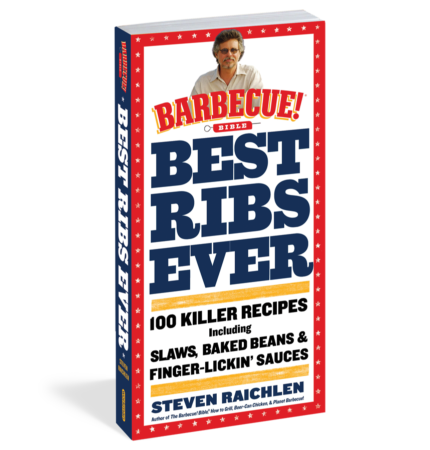
Best Ribs Ever: Briskets are imposing and pulled pork sure feeds a crowd, but when it comes to iconic barbecue, you just can’t beat the primal pleasure of gnawing the meat off a rack of ribs. Just in time for Father’s Day is Steven’s updated rib book—complete with chicken-fried spare ribs and grilled angel food cake with fresh berry salsa for dessert.
 Wicked Good Charcoal
: No one wants to find coals in his holiday stocking, but a lot of us would like to burn top notch charcoal in our grills. Made in Maine, Wicked Good is just that—large, clean-burning, pure natural hardwood lump charcoal that burns exceptionally hot and clean. For extra points and an extra special Dad, add one of Steven’s
Best of Barbecue® chimney starters—the biggest toughest starter around.
Best of Barbecue Grill Oiler: “Keep it hot. Keep it clean. Keep it lubricated.” With these words Steven launched a grilling revolution, and here comes the coolest way to oil your grill grate yet. Fill the bottle with vegetable oil and rub the oiler over the grate. The metal shield protects your hand. We loved using it at BBQ U.
 Planet Barbecue Grilling Butters
: Butter up your special Dad with a set of Steven’s Planet Barbecue Grilling Butters. White truffle, black truffle, fines herbes, and barbecue butter. Slather them on grilled steaks, chops, fish, corn, even oysters.
Best of Barbecue® Flip Tip Instant Read Meat Thermometer: There’s only one way to make sure your smoked briskets and pork shoulders are cooked to the correct temperature: use an instant read meat thermometer. Steven’s new Flip Tip gives you a precise digital readout, with target temperatures for all the major meats printed on the casing. Probe folds back into the case when you’re not using it.
 Wicked Good Barbecue
: Andy Husbands is a rarity among pit masters—a proper chef who actually understands the art of rubbing, saucing, and slow-smoking meats. He certainly has the championship trophies from Memphis in May, the Jack Daniels, and the Kansas City Royal to prove it. From prize-winning brisket to ribs to poultry, this is simply one of the best how to books we know of on how to prepare championship barbecue.
Best of Barbecue® Four Compartment Trout Basket: Take it from us: There’s no better way to cook fish than grilling, but how do you prevent it from sticking to the grill grate? Enter Steven’s new four compartment fish basket. Stuff four trout with lemon slices and dill. Place bacon slices on top and bottom, close the basket, and grill the fish. It doesn’t get much better than this.
A year’s subscription to the Fresh-Pressed Olive Oil Club. If we could bring only one grilling condiment to a desert island, it would be extra-virgin olive oil—the fragrant fruity oil that serves equally well as a lubricant, moisturizer, and flavoring. Members receive three bottles per quarter of the freshest olive oil the world has to offer, hand-picked by the Club’s expert olive oil scouts and shipped by air within days of pressing.
Primal Grill complete DVD set. Over 100 recipes for grilling, smoking, barbecuing, roasting and more on 26 full episodes of the hit public television show!
 Grilling4all.com gift certificate
. The ultimate gift for the do-it-yourself Dad—a gift certificate for his favorite Steven Raichlen grilling tools, fuels, and accessories in any denomination you desire. Because when it comes to grilling—as in everything else in life—Father knows best.
Yours in righteous grilling,
Steven Raichlen, Grill Master and Editor-in-Chief
Nancy Loseke, Features Editor

UP IN SMOKE
PART 1 – RIB TIPS : HOW TO UP YOUR GAME
WITH SLABS AND BONES
We want to talk to you about rib tips. No, not those tasty cartilaginous bits that connect the nether ends of spare ribs. Although, we’d make a special trip to Kansas City just to eat the rib tips at B.B.’s Lawnside. (See the recipe below.)
No, we’re talking about tips for preparing and grilling or smoking ribs, so you can make the best racks on the block.
Here are 10 tips to make you a pro.
1. Choose the right rib. Baby backs make great starter ribs. They’re tender, well-marbled, and quick and easy to cook.
2. When buying ribs, look for plump, meaty racks. Avoid “shiners”—ribs with so much meat removed you see the shiny bones. This is a problem most often seen with beef ribs.
3. Pedigree counts: Sure, you can make taste racks with supermarket ribs, but for really extraordinary bones, use a heritage breed, like Berkshire or Duroc. A dependable source is www.heritagefoodsusa.com.
4. Remove the membrane: The papery membrane (pleura in anatomical terms) is tougher than the meat below it and impedes the absorption of the spice and smoke flavors. Insert a slender implement, such as the tip of a meat thermometer, between the membrane and one of the bones under it. (The best place to start is one of the middle bones.) Using a paper towel or pliers to gain a secure grip, pull off the membrane. Note: some members of our barbecue community leave the membrane on to provide a contrast of textures. Your call.
5. Great ribs are made by applying multiple layers of flavor. Use a rub or marinade to apply the base layer. Swab on a mop sauce to apply a second layer of flavor and keep the ribs moist during cooking. Apply the barbecue sauce at the end as a lacquer or glaze. And of course, the wood smoke provides the most important flavor of all.
6. The basic formula for a rub is salt, pepper, paprika, and brown sugar (in roughly equal proportions). Customize by adding garlic or onion powder, chili powder or cumin, or even a ringer ingredient, like ground coffee or cocoa.
7. Avoid the “guy syndrome” (if some is good, more is surely better). This applies to rub, hot sauce, and wood smoke. Often just enough is enough.
8. You can cook ribs by at least four methods: direct grilling, indirect grilling, smoking, and spit-roasting.
Direct grill tender cuts, like pork country-style ribs, or Argentinean cross-cut beef ribs (see pages 159 and 199, respectively, in Best Ribs Ever by Steven Raichlen, Workman, 2012)
Indirect grill tender fatty ribs, like baby backs.
Smoke tough meaty ribs with a lot of connective tissue, like spare ribs.
Don’t forget spit-roasting, which is great for lamb ribs or Brazilian style baby backs (see pages 222 and 119, respectively)
9. If smoking ribs, maintain temperatures of 225° to 250°F. If indirect grilling ribs, maintain temperatures of 325° to 350°.
10. Never, I repeat never, boil your ribs prior to grilling. Boiling denatures the flavor and texture. (That’s what you do to bones to make stock.) You can achieve the requisite tenderness by indirect grilling or smoking. The same holds true for baking or braising prior to grilling. Don’t do it!
BB’S RIB TIPSSource: The Best Ribs Ever by Steven Raichlen (Workman, 2012)
Method: Smoking
Serves: 4
1 tablespoon coarse salt (kosher or sea)
1 tablespoon freshly ground black pepper
1 tablespoon sugar
1 tablespoon sweet paprika
1 tablespoon garlic powder
1 tablespoon meat tenderizer
1/4 teaspoon cayenne pepper
4 to 5 pounds rib tips
Spicy Apple Barbecue Sauce (recipe follows)
You’ll also need: 4 cups hickory chips or chunks, or as needed
Make the rub. Place the salt, pepper, sugar, paprika, garlic powder, meat tenderizer, and cayenne in a bowl and stir to mix, breaking up any lumps with your fingers.
Arrange the rib tips on a baking sheet. Sprinkle on both sides with the rub, rubbing the spices into the meat.
Set up your smoker and preheat to 225° to 250°.
Arrange the seasoned rib tips bone side up in your smoker. Smoke until nicely browned and very tender, 5 to 6 hours in all, turning the rib tips over half way through.
Transfer the rib tips to a cutting board and cut widthwise into 1-1/2 inch pieces. Figure on 7 or 8 pieces for serving. Spoon a little Spicy Apple Barbecue Sauce over the ribs, serving the remaining sauce on the side.
Spicy Apple Barbecue Sauce
Makes about 2-1/2 cups
1 cup ketchup
2 cups apple juice
1/3 cup molasses
1/4 cup cider vinegar
1/4 cup dark brown sugar
2 tablespoons granulated sugar
1-1/2 teaspoons mild red pepper or chili powder
1 teaspoon ground cinnamon
1/2teaspoon ground cloves 1/2 teaspoon celery seed
Coarse salt (kosher or sea) and freshly ground black pepper
Place the ketchup, apple juice, molasses, vinegar, brown and granulated sugar, celery seed, red pepper, cinnamon, and cloves in a large heavy saucepan and gradually bring to a boil over medium heat, whisking to mix.
Reduce the heat to low and simmer the sauce until thick and richly flavored, about 40 minutes, whisking often. When properly reduced, you’ll have about 2-1/2 cups. Correct the seasoning, adding salt and pepper to taste. The sauce should be highly seasoned.
Become a fan on Facebook and get more great recipes!
Yours in righteous grilling,
Steven Raichlen, Grill Master and Editor-in-Chief
Nancy Loseke, Features Editor

UP IN SMOKE
INTRODUCING STEVEN RAICHLEN’S NEW GRILLING BUTTERS!

“Butter! Give me butter! Always butter!”
—Fernand Point
Dear Grilling Enthusiast,
Now available online from earthy.com—and just in time for your summer grilling and barbecuing—Steven Raichlen’s new line of flavored butters.
Developed in collaboration with his longtime friends Amy and Thierry Farges, founders of the award-winning company “Aux Delice des Bois,” the butters were inspired by the beurres composes Steven and Amy learned to make when they studied at the French culinary school La Varenne in Paris.
The grilling butters are made in small batches in New York State using high-quality, high-butterfat cream from local cows and other fresh ingredients. They come in four unique flavors:
- Fines Herbes Butter with Meyer Lemon: Herbaceous with a clean, citrusy tang. Fantastic with grilled seafood, chicken, pork, and smoke-roasted vegetables.
- Black Truffle Butter: Deeply earthy and fragrant. Bury a disk in the center of an Angus burger, put a pat or two on a sizzling steak, pork chop, or veal chop and let it mingle with the juices, or make a baked potato fit for the gods.
- White Truffle Butter: Rich and aromatic with a handsome blonde color. Tuck under chicken skin, spread on bread before grilling, stir into rice or smoke-roasted potatoes, or melt over grilled asparagus.
- Smoky Barbecue Butter: Loaded with Steven’s favorite barbecue spices, this butter carries a payload of flavor that will enhance anything coming off your grill. Try it on ribs, sweet corn, potatoes, bread, steak, chicken, scallops, shrimp, oysters, or lamb.
The butters are frozen, then packaged with recipe ideas in sturdy insulated containers with ice packs to keep them in pristine condition during shipping. Refrigerate or refreeze upon arrival.
Order yours today, and make this the best grilling summer ever!
And tune in to the Today Show on June 5th to see Steven live!
Yours in righteous grilling,
Steven Raichlen, Grill Master and Editor-in-Chief
Nancy Loseke, Features Editor

UP IN SMOKE
STREAMING VIDEO—STEVEN TO LECTURE AT HARVARD
Watch Steven’s Man, Food, Fire: The Evolution of Barbecue talk streaming live from Harvard University on Tuesday, April 24, at 6 P.M. EST on www.barbecuebible.com.
Did barbecue beget civilization? How did humankind learn to grill? Join bestselling author, PBS TV host and former Watson Fellow, Steven Raichlen, for a provocative lecture on the history of barbecue, from the discovery of live fire cooking by Homo erectus nearly two million years ago to the invention of the charcoal briquette, charcoal and gas grills, and modern barbecue restaurant.

Experience the amazing world of live fire cooking in all of its mouthwatering diversity, from Indonesian sate to Indian tandoori, South African
braai, Brazilian
churrasco, and traditional Texas brisket. Explore the cultural and etymological origins of barbecue, from Taino Indian
barbacoa to Greek gyro and Turkish
shish kebab. Learn about the unexpected contributions to the development of barbecue played by real life figures such as Homer, Apicius, St. Lawrence, George Washington, Abraham Lincoln, and Henry Ford. And learn to tell the difference between barbecuing and grilling, dry rubs and marinades, kettle grills and kamado cookers (like the Big Green Egg). You’ll never again think of barbecue in quite the same way.
For more info on Steven’s lecture, click here.
Steven Raichlen is the multi-award winning author of such international blockbusters as Planet Barbecue, Barbecue Bible, The Best Ribs Ever, and How to Grill, and host of Primal Grill and Barbecue University on PBS. His books have been translated into 15 languages with more than 5 million copies in print. In June, Forge will publish his first novel, Island Apart.
CAVEMAN T-BONE WITH HELLFIRE HOT SAUCEWatch Steven prepare Caveman T-bones with Hellfire Hot Sauce on
YouTube.
Source: Recipe adapted from Primal Grill with Steven Raichlen
Method: Direct grilling
Serves: 4
For the steaks:
4 T-bone steaks (10 to 12 ounces each), cut about 1″ thick
Coarse salt (kosher or sea) and cracked black pepper
For the hellfire hot sauce:
1/2 cup extra-virgin olive oil
6 jalapeño peppers, thinly sliced crosswise
8 cloves garlic, thinly sliced
1/2 cup fresh cilantro leaves, coarsely chopped
Grill the steaks: Build a charcoal fire and rake the coals into an even layer. When the coals glow orange, fan them with a newspaper or hair dryer to blow off any loose ash.
Generously—and I mean generously—season the steaks on both sides with salt and cracked pepper. Place the steaks directly on the embers about 2 inches apart. Grill until cooked to taste, 4 to 6 minutes per side for medium-rare, turning with tongs.
Using tongs, lift the steaks out of the fire, shaking each to dislodge any embers. Using a basting brush, brush off any loose ash and arrange the steaks on a platter. Let the steaks rest loosely tented with aluminum foil, while you make the sauce.
Make the Hellfire Hot Sauce: Heat the olive oil in a cast-iron skillet directly on the embers on the side burner of a gas grill or on the stove. When the oil is screaming hot, add the jalapeños, garlic, and cilantro. Cook over high heat until the sauce is aromatic and the garlic is lightly browned, about 2 minutes. Immediately pour over the steaks and serve at once.
Yours in righteous grilling,
Steven Raichlen, Grill Master and Editor-in-Chief
Nancy Loseke, Features Editor

UP IN SMOKE
A BARBECUE VALENTINE
When a young man arrived to meet Up in Smoke reader Kate Schindler for their first date, he brought her a copy of The Barbecue! Bible. Ms. Schindler, it seems, writes a food blog much appreciated by the soon-to-be-boyfriend (which he thought could use a bit more coverage on grilling). “We now grill together all the time,” reports Kate, “and we’ve been dating ever since!”
Well that’s one lucky guy who got it right. Not so for a friend’s husband, who haplessly gave her a household appliance for Valentine’s Day one year. And not a kitchen or barbecuing one, which she would have appreciated. No, said appliance was a Dirt Devil vacuum. The fact that it was fiery red wasn’t enough to keep him out of the dog house.
If you’re foolhardy enough to contemplate buying an appliance for your sweetheart on Valentine’s Day (which is approaching faster than a freight train), we have one word for you: don’t.
Aside from that advice, we can’t help you much in the gift department (although a Best of Barbecue grilling accessory from www.grilling4all.com has been known to gladden a lot of hearts). What we can do is this: help you plan and pull off a seductive Valentine’s Day dinner featuring foods reputed to be natural aphrodisiacs—served hot off the grill, of course. (You’ll remember from your ancient Greek mythology that Aphrodite was the Greek Goddess of Love.)
What better way to a woman’s or man’s heart than by sharing a meal the two of you grill together? Fire? Check. Togetherness? Check. Teamwork? Check. If you want a refresher on the seductive possibilities of such a dinner for two, rent the timeless film classic Tom Jones and watch the feast scene.
Take it from us: making a meal from scratch for your inamorata is a lot more intimate than making dinner reservations at a restaurant. And nothing says passion like firing up your grill.
We suggest starting with oysters—freshly shucked and grilled under an aromatic Catalan Romesco sauce. Oysters are rich in male libido-enhancing zinc, which may be why Cassanova downed them by dozens. And almonds—one of the key flavorings in the Romesco sauce—are loaded with vitamin E—a compound said to have stimulative properties for both sexes.
Follow the oysters with a simple salad of grilled avocado—halved, seeded, and flamed-seared just long enough to lay on grill marks. Fill the cavities with caviar, crab, or sliced hearts of palm. Drizzle with the best quality extra virgin olive oil (hopefully the only thing virginal that evening) and a vivifying squeeze of fresh lime or lemon. The ancient Aztecs called avocados ahuacuatl (“testicle tree”) in honor of their suggestive shape. As for the Spanish priests in the New World, they found the fruit so provocative, they forbade its consumption.
For a main course, we recommend a simple luxurious protein that can be direct-grilled without fuss. Lobster is a good choice, as is filet mignon. Better yet, combine the two in an amorous surf and turf.
For a side dish, consider speck- or prosciutto-wrapped asparagus. In 19th century France, bridegrooms were traditionally served three courses of this upright-growing vegetable at prenuptial dinners designed to, er, heighten wedding night pleasures. (Scientists have confirmed asparagus to be rich in folic acid—a compound that heightens the senses.)
For dessert, there’s only one choice: chocolate. Like José Andres’ Grilled Bread with Chocolate (see page 112 of Planet Barbecue), which can be made in minutes over the fire’s glowing embers. Chocolate releases dopamine, a chemical that works on the pleasure centers of the brain to stimulate attraction and euphoria.
Add candlelight and mood-enhancing music, and you’ll have the ingredients for a memorable evening. Who knows? Maybe she’ll even forgive that appliance and let you out of the doghouse early.
FRESH OYSTERS WITH ROMESCO SAUCERomesco is a thick, nutty, smoky sauce made with grilled vegetables, nuts and chiles. In Catalonia, Romesco’s birthplace, you’d use a local chile called nyora. Ancho or pasilla chiles come closest in the U.S., or you could use a good pure chili powder. You can balance the shellfish on the bars of the grill grate (okay) or use a shellfish rack (better), which you can find at the Steven Raichlen Barbecue Store. A good oyster knife is also a wise investment.
Serves 2
12 large oysters in the shell (see Note below)
2 tablespoons good-quality Spanish sherry
3/4 cup Romesco Sauce (see recipe below)
Scrub the oyster shells with a stiff brush to remove any grit. Discard any oysters that fail to close when tapped. Shuck the oysters and take care not to spill the oyster juices when you remove the top shell. Carefully arrange the oysters on a shellfish rack (see above) or in a baking pan.
Drizzle a little sherry over each oyster, then top with 1 tablespoon of Romesco Sauce.
Set up the grill for direct grilling and preheat to high. When ready to cook, place the shellfish rack with the oysters on the grill grate (alternatively, balance the shells directly on the grill grate, taking care not to spill their contents). Grill until the sauce and oyster juices are bubbling and the oysters are cooked through, 4 to 6 minutes. Transfer to plates and serve immediately.
Note: One reliable online source for pristine oysters is Farm-2-Market. Their experts suggest firm and fruity Fanny Bay oysters from British Columbia’s Vancouver Island for the above preparation.
SUB-RECIPE: ROMESCO SAUCEThis recipe will make more sauce than you’ll need for the oysters above, but it pairs well with poultry or vegetables, particularly small grilled leeks. Covered and refrigerated, it will keep for 3 days.
Makes 1 to 1-1/2 cups
1/2 ancho or pasilla chile
2 cloves garlic, peeled and skewered on a toothpick
1/2 small onion, cut into 2 wedges through the stem and skewered on toothpicks
1/2 small red bell pepper
1 large or 2 medium fresh, ripe tomatoes
2 tablespoons blanched whole almonds or slivers, toasted
1/4 cup good quality olive oil
1 slice of country-style white bread
1 tablespoon finely chopped fresh Italian (flat-leaf) parsley
1 tablespoon red wine vinegar, or more to taste
Sea salt and freshly ground black pepper, to taste
Set up your grill for direct grilling and preheat the grill to high. Brush and oil the grill grate.
Quickly grill the chile on both sides (10 to 20 seconds in all). Transfer it to a bowl of warm water and let soak for several minutes while you grill the rest of the vegetables. Arrange the garlic, onion, pepper, and tomato(es) on the grill grate and grill until the skin on the pepper is blackened and the other vegetables are nicely browned. This will take 3 to 6 minutes per side. As each is cooked, transfer to a platter and let cool. Remove and discard the toothpicks from the garlic and onion. Very lightly brush the bread on both sides with oil and grill until nicely browned, 1 to 2 minutes per side. Break into small pieces.
Drain the chile pepper, reserving the liquid. Tear the chile into pieces and remove the stem and seeds. If any of the pepper or tomato skins are really charred, scrape off the burnt part with a paring knife. But a little black is good. Place the chile, onion, garlic, pepper, tomato, crumbled bread, and almonds in a food processor and puree to a smooth paste. Add the parsley, vinegar, remaining olive oil, and salt and black pepper. Process until smooth, adding enough of the reserved chile soaking liquid to make a pourable sauce. Correct the seasoning, adding salt or vinegar as necessary: the Romesco sauce should be highly seasoned.
Keep any excess sauce in the refrigerator, where it will keep for at least 3 days.
SPECK-WRAPPED ASPARAGUS SPEARSIf you cannot find Italian speck (a salt-cured smoked ham flavored with juniper and other spices), substitute prosciutto.
Serves 2
12 large asparagus spears
Extra-virgin olive oil
Sea salt and freshly ground black pepper
6 paper-thin slices of Italian speck or prosciutto, cut in half widthwise
With one hand, hold an asparagus spear at its base. Bend the stalk with your other hand: the asparagus will break where the woody part ends and the tender part begins. Discard the woody ends.
Lay the asparagus spears on a rimmed baking sheet or baking pan. Lightly drizzle with olive oil and season with salt and pepper. Wrap each asparagus stalk with a half slice of speck (the ham will adhere to itself).
Set up the grill for direct grilling and preheat to high.
When ready to cook, place the asparagus spears on the grill at right angles to the grill grate bars. Grill the asparagus, turning as needed with tongs, until it is tender-crisp and the speck just begins to brown, 6 to 8 minutes in all. Serve hot or at room temperature.
Yours in righteous grilling,
Steven Raichlen, Grill Master and Editor-in-Chief
Nancy Loseke, Features Editor

UP IN SMOKE
BEET MEETS HEAT
(ROOT VEGETABLES ON THE GRILL)
January 30th, 2012

Veggies on the grill? We all grill high-moisture summer veggies, like corn, zucchini, and asparagus. That’s a given. But what about those sturdy and stalwart roots, tubers, and squashes that proliferate in the produce section in the icy dead of winter?
Well, it turns out you can get as much satisfaction grilling winter veggies as summer. Bright colors and soulful flavors? Check. Rich smoke taste? Check. The smoky sweetness that results from the caramelization of plant sugars? Check.
Call it the endless summer, but winter vegetables enable you to go from garden to grill all year long.
Withal, winter vegetables require special treatment on the grill. Most tend to have a denser texture and lower moisture content than summer vegetables, which makes them better-suited to an indirect grilling method. And many—like sweet potatoes, onions, and winter squash—contain a lot of residual sugar, so they’re prone to burning when grilled over high heat. Here are some of my favorite techniques:
Caveman grilling (directly in or on the embers of a wood or charcoal fire): Especially well-suited to sweet potatoes and onions. Lay the veggies directly on the coals and grill until charred black on all sides, turning with tongs. This takes 30 to 40 minutes. (On a gas grill, you’d crank up the heat to high and direct grill until skins are charred and the flesh is tender.) Use the skewer test below to check for doneness. To serve, cut the veggies in half and drizzle with olive oil, butter, or balsamic syrup. The charred skins impart an incredible smoke flavor.
Indirect grilling/smoke-roasting: Winter squash, whole cabbages and onions, whole beets, rutabagas, turnips, celery root, etc.. Cut acorn squash in half and stuff with beans, wild rice, and cheese to make a terrific meatless entrée. For cabbage and onion, remove the stem and core (cut it out in a cone-shaped plug) and stuff it with bacon, butter, and barbecue sauce. Indirect grill until soft, about 1 hour. For a smoke flavor, add wood chips to the fire. Pull off any charred leaves before serving.
Pan-roasting in a cast iron skillet or disposable foil pan: Pan-roasted carrots, parsnips, leeks, Brussels sprouts, and fingerling potatoes are all the rage at fashionable restaurants these days. They’re easy on the grill (and even better than in the oven because you can add a smoke flavor). Cook whole or cut into 2-inch chunks. Arrange in a single layer in a cast iron skillet or aluminum foil pan and season with extra virgin olive oil or butter and sea salt and freshly ground black pepper. Indirect grill at medium-high heat (about 400 degrees) until browned and tender. To make garlic roasted potatoes, break up a head of garlic (leave the skins on the cloves) and add to a pan full of fingerling potatoes. Brussels sprouts are terrific roasted with thinly sliced bacon.
A few other points to keep in mind when grilling winter vegetables:
- To hold round vegetables like acorn squash and cabbage upright, crumple and twist sheets of aluminum foil into 2-inch rings and place the vegetables on top.
- To add a smoke flavor, toss fruit wood or hickory chips on the coals (or place in the smoker box of your gas grill).
- When grilling vegetables “caveman style”, use a metal skewer to check for doneness. It should pierce the vegetables easily.
- When indirect grilling whole round vegetables, use the “Charmin test” to check for doneness—the sides of the vegetable should be squeezably soft.
Whole vegetables like potatoes, beets, turnips, sweet potatoes, etc., take about one hour to cook—sometimes more. To shorten cooking times, cut the vegetables into chunks, slices, or cubes. Or parboil, which is especially useful for artichokes. (I try to do everything from start to finish on the grill. But that’s me.)
One of the best grilled winter squash dishes I know comes from a restaurant right here in Miami: the Asian-inflected Gigi in Midtown.
 ROASTED BUTTERNUT SQUASH WITH PEPITAS AND MAPLE-MEYER LEMON GLAZEButternut squash is one of the few winter vegetables you can direct grill, but work over a moderate heat to cook it through without burning. Gigi serves the squash with a spicy sweet-sour reduction of house-pickled Fresno chili juice. Heat-seakers can use pickled jalapeno peppers.
Method: Direct grilling
Serves: 4
1 large butternut squash,1 to 1-1/2 pounds
Extra virgin olive oil
Coarse salt and freshly ground black pepper
For the glaze:
3 tablespoons unsalted butter
3 tablespoons pure maple syrup
1 tablespoon juice from a Meyer lemon, or more to taste
1 tablespoon pickled jalapeno juice (optional)
1/4 cup toasted pepitas (pumpkin or squash seeds)
Set up the grill for direct grilling and preheat to medium, about 350°F.
Peel the squash and cut in half lengthwise. Scoop out any seeds with a spoon, then cut crosswise into 1/2-inch slices. Lightly brush the squash slices on both sides with olive oil and season with salt and pepper.
Brush and oil the grill grate.
Arrange the squash slices on the grate and grill until browned and tender, 6 to 10 minutes per side, turning with a spatula. If the squash starts to burn, lower the heat.
Make the glaze: In the meantime, melt the butter in a small saucepan over medium-low heat on the stovetop. Add the maple syrup, lemon juice, and jalapeno juice.
The last couple minutes of grilling, brush the squash slices with a little glaze. Arrange the cooked squash on a platter and pour the remaining glaze over it. Sprinkle with the toasted pepitas, and dig in.
Yours in righteous grilling,
Steven Raichlen, Grill Master and Editor-in-Chief
Nancy Loseke, Features Editor
and the staff at Workman Publishing

UP IN SMOKE
RETURN OF THE WINTER WARRIOR

A snow-capped WeberIt wasn’t so long ago that people routinely retired their grills after Labor Day, stowing them in a corner of the garage or basement to commiserate with the golf clubs until better weather.
My, how times have changed. Whether it’s due to larger investments in grills and outdoor kitchens, a protracted appetite for the smoky flavors of summer, or the continued need for barbecue bragging rights, live fire cooking outdoors has become a four season endeavor. The Hearth and Patio Barbecue Association reports that the majority of Americans (56% in its latest survey) grill year-round.
Now, you might wonder why you’d accept winter grilling advice from a man whose home base is Miami, Florida. Well, I grew up in Maryland and lived in Boston for 20 years, and book tours and television shoots—not to mention regular winter excursions to Martha’s Vineyard—keep me up on grilling in inhospitable weather. And even when I’m in Miami, I grill vicariously through my Cleveland-based assistant, Nancy Loseke, who claims her traditional Christmas Eve lamb roast always turns out better when the weather outside is frightful, and she wears high heels for traction around the ice- and snow-packed grill. (I guess spike heels work like crampons?) Nancy doesn’t have photos, or so she claims, but says she can produce witnesses…
Here are some indispensable tips for winter grilling:
- Dress appropriately. Dashing through the snow in jeans and your team sweatshirt during commercial breaks from the game suggest you’re not taking your grilling seriously. Dress warmly, avoiding dangling nylon cords, ultra-puffy sleeves, etc., that could brush up against the fire. Wear good-quality griller’s gloves in lieu of mittens or nylon ski wear.
- If snow is a factor, clear the space around your grill and sprinkle it with sidewalk salt to give yourself better traction. Likewise, if there’s snow on branches directly over the grill, knock it off, or move the grill.
- If using a propane grill, make sure the tank is full before starting your grill session. Preheat it for five minutes longer than normal. (Food should sizzle when it touches the grill grates.) If using charcoal, preheat your grill with about 25% more charcoal than normal to compensate for cold temperatures.
- For maximum efficiency, position your grill out of the wind but at least five feet from flammable surfaces. Do not be tempted to move your grill into the garage or under a covered patio. Carbon monoxide poisoning is nothing to fool around with.
- Resist the temptation to check on your food often as heat will quickly escape each time you lift the lid.
- Add 20-30% to your cooking times in cold temperatures.
- A welder’s blanket (not the version made with fiberglass) when thrown over the lid of a low-temperature smoker (225°-250°) helps hold the heat in.
- In the wintertime, if you’re in a hurry, plan menus built around foods that can be direct grilled in 30 minutes or less, such as burgers, brats, chicken breasts, shrimp, fish fillets, etc.
- Don’t overcrowd your grill grate. Allow the heat to circulate freely around the food.
- Invest in a cover to protect your grill from the elements when not in use.
- Replace your grill grates with cast iron grates, which retain heat much better than stainless steel or porcelain-coated grates. Or, lay Steven’s Tuscan Grill Grate right on top of your grill grate. Cast iron also produces killer grill marks!

Steven on the snowy set of his Canadian show, Le Maitre du GrillBelow is an incentive to brave the elements and shovel a path, if necessary, to your grill.
MEXICAN MOLE BEEF SHORT RIBS WITH COLORADITO SAUCEMexico’s mole sauces are not traditionally paired with beef short ribs, but their earthy fruitiness complements the richness of of the meat. Coloradito is one of Oaxaca’s classic sauces. Do not be intimidated by the length of the recipe. It is actually quite easy to make, especially if your tool of choice is a blender—and not a molcajete.
Method: Indirect grilling
Advance preparation: 6 to 12 hours for marinating the ribs
Serves: 4
For the coloradito sauce:
7 guajillo chiles
1 ancho chile
2 cups warm water
2 tablespoons vegetable oil
1 small onion, rough-chopped (about 3/4 cup)
2 cloves garlic, rough-chopped
1/2 teaspoon ground cumin
1 cinnamon stick
1 clove
2 tablespoons sesame seeds
1 teaspoon dried oregano
1 bay leaf
1 teaspoon coriander seeds
1/2 ripe plantain, peeled and diced (about 1/2 cup)
1/3 cup yellow raisins
1/4 cup slivered almonds
1/2 cup crushed tomatoes with their liquid
1 ounce unsweetened chocolate, rough chopped
2 teaspoons brown sugar (or to taste)
2 teaspoons red wine vinegar (or to taste)
1/2 to 1 cup beef broth or water
For the ribs:
6 cloves garlic, coarsely chopped
1 tablespoons coarse salt (kosher or sea)
1 to 2 tablespoons extra-virgin olive oil or vegetable oil
3 to 4 pounds bone-in beef short ribs
Freshly ground black pepper
Pure chile powder, such as ancho
Dried oregano, preferably Mexican
You’ll also need: 1-1/2 cups wood chips, soaked in water to cover for 1 hour, then drained
Prepare the coloradito: Tear open the guajillo and ancho chiles and remove the stems and seeds. Place the chiles in a bowl with 2 cups warm water to cover and let soak until softened, 15 minutes.
Heat the oil in a large saucepan over medium-high heat. Add the onion and garlic and cook until translucent but not brown, stirring with a wooden spoon, about 3 minutes. Add the cumin and cook for 1 minute.
Drain the chiles, reserving the soaking liquid, and add them to the onion mixture. Sauté the mixture until fragrant, about 2 minutes. Add the soaking liquid, cinnamon, clove, sesame seeds, oregano, bay leaf, coriander seeds, plantain, raisins, almonds, tomatoes, chocolate, brown sugar, wine vinegar, and salt (start with 1 teaspoon). Gently simmer the mixture until the plantains and raisins are soft, about 20 minutes, stirring occasionally. Remove the cinnamon stick. Transfer the sauce to a blender and puree until smooth. Return the mole to the saucepan.
Add 1/2 to 1 cup of the beef broth—enough to obtain a thick but pourable sauce. Correct the seasoning, adding salt, sugar, or vinegar to taste—the sauce should be highly seasoned and a little sweet with just a faint hint of tartness. The coloradito can be prepared several hours or even a day ahead and reheated.
Prepare the ribs: Add the garlic cloves to a mortar and sprinkle them with the salt. Using a pestle, pound them until they are thoroughly crushed. Blend in enough oil to make a paste. Spread the garlic paste on all sides of the ribs, then sprinkle the ribs generously on all sides with black pepper, chile powder, and oregano. Arrange the ribs in a nonreactive pan and cover tightly with plastic wrap. Refrigerate for 6 to 8 hours, or overnight.
Set up a charcoal grill for indirect grilling and preheat to medium (325-350°F). Place a large drip pan in the center of the grill under the grill grate.
When ready to cook, brush and oil the grill grate. Place the ribs bone side down in the center of the grate over the drip pan and away from the heat. Toss the wood chips on the coals. Cover the grill and cook the ribs until cooked through and very tender, 1-1/2 to 2 hours in all. (If they start to brown too much, wrap them tightly in aluminum foil.) Replenish the coals as needed.
Generously brush the short ribs on all sides with the coloradito. Put the ribs directly over the coals and sizzle for 1 to 2 minutes per side, turning with tongs. Transfer to a platter or plates, and serve with additional coloradito sauce on the side.
If you have winter grilling tips you’d like to share, send them to me at sraichlen@barbecuebible.com.
Yours in righteous grilling,
Steven Raichlen, Grill Master and Editor-in-Chief
Nancy Loseke, Features Editor

UP IN SMOKE
BARBECUERS’ GIFT GUIDE 2011
It’s once again our pleasure to assemble a list of gift ideas that will delight the barbecuers on your holiday list (including you). The challenge is always winnowing the list down to our top twelve—items we’d actually like to receive ourselves—from stocking stuffers (a remote wireless thermometer) to once-in-a-lifetime gifts (a gift certificate to Barbecue University).
All of us at BarbecueBible.com wish you Happy Holidays and a healthy New Year.
THE SMOKING GUN™: The flannel shirt, the socks, the car care kit…you mumble your thanks to well-intentioned givers. But admit it: What you really want are toys. Maybe even toys that run on four AA batteries. Well, The Smoking Gun™ qualifies. It looks like a blow dryer tricked out with a rubber hose—not normally a good look in serious barbecue circles. But in 30 seconds, it will infuse meat, seafood, vegetables, cheese, and even cocktails (like classic Manhattans) with real wood smoke. It has a good pedigree, too, being the least expensive product invented by PolyScience, a serious U.S.-based company known for commercial and industrial temperature-control devices. Available online through abt.com.
PRIMAL GRILL WITH STEVEN RAICHLEN DELUXE BOXED DVD SET: To paraphrase the old saying, give a man a smoked brisket sandwich and he’ll eat well for a day. Teach him how to smoke that brisket and he’ll eat well for a lifetime. What better gift that keeps on giving than the boxed set of the complete seasons 1 and 2 of Steven’s popular PBS show, Primal Grill. Twenty-six episodes (10 hours of programming), more than 100 recipes, and Steven’s favorite tips and techniques are included in this 8-DVD set.
 THE JAPANESE GRILL:
Some of you may know that Steven was born in Japan (on a U.S. Air Force base in Nagoya). So any with a theme of Japan and grilling certainly grabs his attention.
The Japanese Grill (Ten Speed Press, 2011) by Tadashi Ono and Harris Salat does a masterful job of melding Japanese food sensibilities with American live-fire cooking. Even the book’s cover, which features an artfully carved porterhouse steak, is worth a visit to
amazon.com or your local bookseller.
PLANET BARBECUE® SPICE PASTES: New this year! Bring bold and exciting flavors to your next barbecue with these unique spice pastes inspired by Steven’s world travels. Choose from Colombian, Jamaican, Malaysian, or Moroccan. Add a copy of Steven’s book Planet Barbecue (Workman, 2010) to further inspire. Order both from grilling4all.com.
 FROGMATS:
Foods that tend to stick to the grill grate or fall into the fire are the bane of grill masters everywhere. Enter Frogmats, nonstick sheets of wire mesh that lay directly on the grill grate. Owner Mike Riblett, whose 15 tattoos of frogs on lily pads inspired the product’s curious name, uses his for meatballs, biscuits, small vegetables (such as green beans or sliced mushrooms), shrimp, and even meatloaf. Frogmats are heat-resistant to temperatures of 550°F, and intended only for indirect grilling. They come in a variety of sizes. There is a dealer map on the company’s website (
frogmats.com), or you can buy them from
poppasmokers.com.
BODUM FYRKAT CONE CHARCOAL GRILL: This unique cone-shaped grill from Bodum (best known for its coffee presses) fuses functionality and sleek Scandinavian design. Perfect for a party of two, the grill features two grill grates—one closer to the coals for steaks, chops, etc., and the other several inches above it for breads or slower-cooking items—as well as a battery-powered rotisserie sturdy enough to accommodate a 6-pound chicken. Ashes accumulate in the bottom and empty easily. It comes in cool colors, too: red, orange, green, and black. amazon.com
 PREMIUM SEAFOOD:
When it comes to seafood in the U.S., the distribution chain can be disturbingly long. From the fisherman, this highly perishable product usually travels to a middleman, then to a wholesaler, then to a retailer, and finally, to you. But
Farm-2-Market contracts directly with the fishermen as soon as it receives your order. This cyber-storefront carries no actual inventory, but can deliver the catch-of-the day to your door within 24 hours. Live California spot prawns are being offered at this writing, as are halibut cheeks, sushi-grade blue fin tuna, crawfish, stone crab claws, and no less than 8 different kinds of oysters. Check out
farm-2-market.com for your holiday seafood needs.
BEST OF BARBECUE® INSULATED FOOD GLOVES: As anyone who has tried to pull blistering hot pork can tell you, it’s an uncomfortable experience unless you have the calloused hands of a professional pit master. Ditto for lifting a finished beer can chicken off its aluminum throne. Sure, you could press your wife’s rubber dish washing gloves into service, but you don’t really know where those gloves have been, do you? Not that your wife will be happy, and in any case, they don’t fit. Since Steven first introduced his insulated food gloves to the market, they’ve become one of his bestsellers. Light and flexible, these heavy-duty gloves will protect your hands to temperatures of 248°F.
MAVERICK ET-732 WIRELESS REMOTE THERMOMETER: There are several intuitive ways of gauging doneness in foods that are grilled directly—chicken breasts, hamburgers, fish fillets, etc. But an accurate thermometer is called for when larger hunks of protein—pork shoulder, beef shoulder clod, and brisket, to name a few—are on the grill or smoker. For less than the cost of a 3-bone prime rib, you can arm yourself with a high-tech remote thermometer, one that will allow you to watch the big game while your meat cooks to perfection. Two probes, one for the meat and one for the grill, allow you to monitor conditions from up to 300 feet away using an LCD receiver. Find it at amazon.com.
 THE MEADOW:
Food-obsessed Portland, Oregon, is home to one of Steven’s favorite retail stores, The Meadow. Opened in 2006 by Mark and Jennifer Bitterman, The Meadow specializes in salts of the world, chocolate, wine, flowers, and bitters, a new interest for Steven. (Mark is the author of
Salted: A Manifesto on the World’s Most Essential Mineral, which we featured in last year’s gift guide.) The Meadow’s “Salt Starter Kit” featuring six distinct salts from around the globe would make a fine gift for anyone interested in the nuances of seasoning. Gift certificates are available, too.
atthemeadow.com
CRÈME BRULEE GRILL KIT: One of the most dramatic moments in filming Season 3 of Primal Grill came when Steven lowered a fire-heated cast iron salamander to the surface of a silky crème brulee: It sizzled and smoked as the sugars caramelized to a hard candy-like shell that begged to be shattered by a spoon. So successful was the experiment that Steven decided on the spot to add a crème brulee set to his Best of Barbecue® line. Each kit includes the salamander and two cast iron crème brulee ramekins along with a recipe. (Extra ramekins are sold separately.) grilling4all.com
And finally, the ULTIMATE gift for any griller:
BBQ UNIVERSITY 2012: Barbecue with a high thread count? Yes! This is a very special, very exclusive gift for anyone interested in perfecting their barbecue skills or making memories—a certificate redeemable for Barbecue University® at the luxurious Broadmoor resort in Colorado Springs, Colorado. It’s three days of food, fun, and camaraderie in the Rocky Mountains. Steven will be teaching two sessions of “BBQ U” of limited class size. At this writing, there are only 5 places available in the first session (June 6 – 9) and 10 in the second (June 9 to 12). For more information, contact the Broadmoor’s Reservation Manager, Noemi Kiss-Baldwin at 1-800-634-7711, or e-mail her at NKiss-Baldwin@broadmoor.com.
Yours in righteous grilling,
Steven Raichlen, Grill Master and Editor-in-Chief
Nancy Loseke, Features Editor

UP IN SMOKE
THANKSGIVING EDITION
Turkey, plattered up and as burnished as George Hamilton, is the undisputed star of Thanksgiving dinner in most American households. (Vegetarians, take comfort—we have you covered below.) Substitute anything else—prime rib, ham, or Cornish hens—and you will disappoint the adults at your table and make the children cry. It’s as disheartening as waiting all year to attend a Broadway show only to arrive when an understudy is playing the lead role.
The only real latitude an adventuresome cook has on Thanksgiving is with the side dishes, and even then, freedom is not without its limits. There must be stuffing. There must be mashed potatoes. And in your household, perhaps, an immutable family tradition like marshmallow-topped yams or a certain green bean casserole birthed from cans. (In the Raichlen household, it’s my mother’s cranberry and kumquat relish. See the recipe below.)
That being said, wouldn’t it be refreshing to add some new side dishes to your repertoire—dishes that will not only invigorate your Thanksgiving menu, but that also can be prepared on the grill, taking some of the pressure off your beleaguered oven? Of course it would.
Living here in America, or wherever you call home, we have a lot to be thankful for this year. Health. Happiness. Barbecue and grills. So from my family to yours, we wish you a happy Thanksgiving.
Note: In honor of Thanksgiving, over the next two weeks, Steven will give you his 2011 “Thanksgiving in the Tropics” menu he’ll be making in Miami, complete with recipes, on his Facebook page. Also please join us on Twitter.
GRILLED OYSTER “STEW” ON THE HALFSHELLHistorians tell us oysters were likely served at the first Thanksgiving. This recipe riffs on oyster stew—cooked on the halfshell on the grill.
Method: Direct grilling
Serves: 6 to 8 as an appetizer
- 24 large oysters
- 1-1/2 cups heavy (whipping) cream
- Worcestershire sauce
- 8 tablespoons (1 stick) salted butter
- Sweet paprika
- 2 scallions, trimmed, white and green parts finely minced
- Small oyster crackers for serving
You’ll also need: A shellfish rack
Scrub the oyster shells with a stiff brush to remove any grit or mud. Discard any oysters that fail to close when tapped. Shuck the oysters: Set the oyster, flat shell side up, on a damp dishcloth on your work surface. Wiggle the tip of an oyster knife into the hinge and gently push the knife handle down. The shell should pop off. Slide the knife blade under the top shell to cut the adductor muscle, then discard the top shell. (Take care not to spill the oyster juices.)
Arrange the oysters on a shellfish rack or baking sheet, being careful not to spill the juices. Put a tablespoon of cream on each, along with a few drops of Worcestershire sauce. Top with a teaspoon of butter and dust lightly with paprika. Sprinkle with scallions.
Set up the grill for direct grilling and preheat to high.
When ready to cook, place the rack with the oysters on the hot grate (or arrange the oysters directly on the grill grate) and grill until the sauce and oyster juices are bubbling and the oysters are cooked through, 3 to 6 minutes. Serve the oysters hot off the grill accompanied by oyster crackers.
GRILLED ACORN SQUASH WITH WILD RICE, DRIED FRUIT, AND NUTSHere’s an incredibly flavorful stuffing made with wild rice, nuts, and fruit, the whole shebang indirectly grilled in acorn squash halves. It’s a side dish that will make omnivores sit up and take notice, and a welcomed show-stopping entrée for any vegetarians who show up at your Thanksgiving table.
Method: Indirect grilling
Serves: 6
3 good-size acorn squash
6 tablespoons salted butter plus 2 tablespoons for finishing
1 leek or onion, trimmed and chopped
2 stalks celery, strings removed and diced
1 clove garlic, minced
1 apple, peeled, cored, and diced
1/2- to 1 cup vegetable broth, preferably homemade
1 teaspoon poultry seasoning
Salt and freshly ground black pepper
6 dried plum or apricot halves, diced
1/2 cup dried cranberries
1/4 cup yellow raisins
2 tablespoons Madeira or sherry
5 cups cooked wild rice
1 cup toasted pecans or walnuts (optional)
You’ll also need: 1 cup maple or other hardwood chips, soaked for 30 minutes, then drained (optional)
6 Best of Barbecue Grill Rings or aluminum foil grill rings.
Slice each squash in half widthwise. Using a metal spoon, scoop out the seeds and stringy, fibrous parts. Melt 6 tablespoons butter in a saute pan. Lightly brush the inside of each squash half with a little of the melted butter. Place each squash half on a grill ring.
Working over medium heat, sauté the leek, celery, garlic, and apple in the remaining melted butter until lightly browned, about 5 minutes. Stir in the poultry seasoning and 1/2 teaspoon each of salt and black pepper. Add 1/2 cup of broth as well as the plums, cranberries, raisins, and Madeira. Simmer for 5 to 8 minutes until the dried fruits soften. Stir in the wild rice and the nuts. If the mixture seems dry, add more broth. Taste for seasoning, adding more salt and pepper if necessary. Stir in the pecans, if desired.
Fill each squash half with 1/6 of the rice and fruit mixture. Top each with 1 teaspoon of the remaining butter.
Set up the grill for indirect grilling and preheat to medium (350°F). Toss the wood chips, if using, on the coals. Arrange the squash on their rings upright on the grill grate away from the heat. Indirectly grill the squash until tender, 40 to 60 minutes. (Use a metal skewer to test for doneness—it should pierce the squash easily.)
FRANCES RAICHLEN’S CRANBERRY KUMQUAT RELISHMy mother wasn’t much of a cook (that’s putting it mildly), but she did make and love this astringent, bracingly tart cranberry relish. Think of it as cranberry sauce for grownups.
Serves: 8 to 10 (makes about 2 cups)
1 package (12 ounces) fresh cranberries
6 kumquats or 1 small orange (see Note below)
1/2 cup shelled walnuts or pecans
1/3 cup firmly packed light brown sugar
1/2 teaspoon ground cinnamon, or more to taste
3 tablespoons port or dry red wine
2 tablespoons honey, or more to taste
Rinse, drain, and pick through the cranberries, removing any stems and discarding any that are blemished. Cut each kumquat into quarters and remove the seeds. Place the kumquats and walnuts in a food processor and coarsely chop, running the mixture in short bursts. Add the cranberries, brown sugar, and cinnamon and coarsely chop. Add the port and honey and pulse the processor just to mix. The relish should have some chew to it. Taste for seasoning, adding more honey and/or cinnamon as necessary.
Note: If using an orange instead of kumquats, cut it into 8 pieces and remove any seeds before adding it to the food processor.
Yours in righteous grilling,
Steven Raichlen, Grill Master and Editor-in-Chief
Nancy Loseke, Features Editor